What Does a Medical Expert Witness Do?
Kalivar
10/21/2026
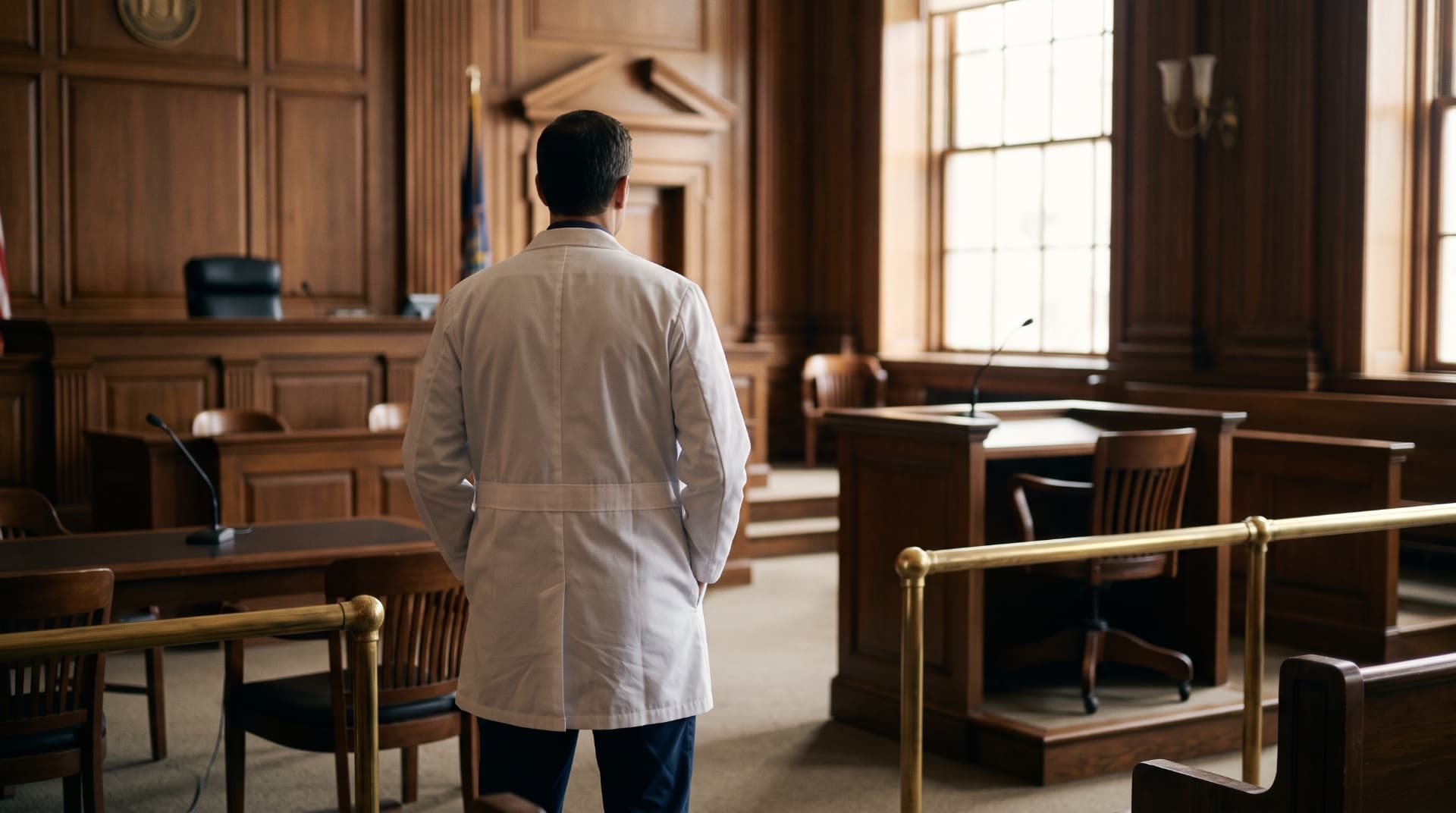
A medical expert witness is a physician who helps a judge, jury or attorney understand medical facts they are not trained to read. The expert answers two questions: did the care meet the standard of care, and if not, did that deviation cause the injury? The job is to educate, not to advocate for whoever pays the fee.
Key takeaways
- A medical expert witness acts as an impartial educator and a translator between clinical reasoning and legal logic.
- Every review comes down to two questions: was the standard of care met, and did any deviation cause the harm?
- A deviation alone is not enough for a case. Causation must also be present, and many bad outcomes happen despite excellent care.
- A fact witness describes what they personally saw. An expert witness interprets facts created by others.
- Credibility rests on three things: competence, clarity and impartiality.
- Telling an attorney "you do not have a case" is part of the job, and it earns respect.
What does a medical expert witness actually do?
Attorneys and judges cannot read an operative report and tell a known complication from negligence. They need someone who can. That is the expert's role: to take the medicine, explain it in plain language, and give an honest opinion about what happened and why.
In Inside the Expert Witness World, Michael Kalivar describes the expert as an impartial educator who translates between two professions that reason very differently. Clinicians think in probabilities, guidelines and judgment calls made in real time. Lawyers think in duties, breaches and proof. The expert connects the two.
In practice, the work usually includes:
- Reviewing records and forming an independent opinion.
- Writing a report or giving a verbal opinion to the attorney.
- Taking part in conferences as the case develops.
- Sitting for a deposition, if the case moves forward.
- Explaining the medicine to a jury, if the case reaches trial.
What is the standard of care?
The first question is whether the standard of care was met. The standard of care is what a reasonably competent physician with similar training would have done under comparable circumstances, at the time the care was given.
Three points matter here:
- Reasonableness, not perfection. The standard does not ask whether a better outcome was possible. It asks whether the care was reasonable.
- Evidence, not hindsight. An opinion should rest on guidelines and the medical literature available at the time. Knowing how the case ended is exactly what makes hindsight tempting and unfair.
- Specialty matters. The comparison is to a physician with similar training. Deviation in one specialty is judged by an expert from that specialty.
What is causation, and why is a deviation not enough?
The second question is whether any deviation caused the injury. A breach of the standard of care without harm does not support a claim.
Here is the worked example from the book. A radiologist misses a 1.5 cm liver metastasis on a surveillance CT scan in a patient with colon cancer. That is a deviation.
- If another CT scan a week later finds the lesion, there is likely no harm. A one-week delay does not change the outcome.
- If the lesion is found six months later, with disseminated disease, both deviation and causation are present.
The same missed finding gives two very different cases. This is why the expert must work through both questions every time.
Many bad outcomes happen even with exemplary care. Postoperative bleeding and sepsis can occur despite everything done right. The expert has to separate coincidence from consequence. That discipline protects patients who were truly harmed, and it protects physicians who did nothing wrong.
Fact witness vs expert witness: what is the difference?
A fact witness testifies about what they personally saw or did. "I was the operating surgeon" is a statement of fact. An expert witness interprets facts that other people created, such as records, images and test results, and explains what they mean.
The purpose also differs. A fact witness reports. An expert educates. The book offers a simple rule of thumb: explain the issue as if you were speaking to a fifth-grade student. If a juror cannot follow your reasoning, your opinion cannot help them.
What makes a medical expert witness credible?
The book describes a Credibility Triad:
- Competence. Up-to-date clinical experience and real mastery of the subject.
- Clarity. The ability to turn complexity into accessible reasoning.
- Impartiality. A visible commitment to the truth, not to the party paying your fee.
Impartiality is the one that is easiest to lose and hardest to rebuild.
Legal and ethical obligations
Experts give opinions to a reasonable medical probability, not speculation. They disclose their limitations and any areas outside their expertise, with the same honesty they owe a patient. Ethically, that means:
- Represent the state of the art, not personal preference.
- Revise your opinion when new information changes your analysis.
- Never tailor conclusions to an attorney's strategy.
Stay consistent
Deposition and trial transcripts are public, and opposing counsel will read them. Suppose you testified for a plaintiff that an intraoperative cholangiogram should be done in difficult cholecystectomies when a critical view of safety cannot be obtained. You cannot later tell a jury it is optional because a defense attorney is paying you. Say only what you believe is true, every time.
A lesson from an early mistake
Michael Kalivar opens his book with a story about his own first case. Early in his career, a colleague passed him an attorney's request for a surgical review. The case was a sepsis death after a long stay in the emergency room. He blamed the delay in surgical consultation and told the attorney the case was strong.
A year later, at trial, he saw the problem. The real standard-of-care question belonged to emergency medicine, outside his specialty. The attorney should have retained an emergency medicine expert on deviation and a general surgeon on causation. In his words, "It was, frankly, a disaster."
His lesson: preparation matters more than confidence or credentials, and an expert should say clearly and early when a case involves another specialty. Fifteen years later, he has reviewed hundreds of cases and testified in courtrooms across the country.
Three myths about medical expert witness work
Myth 1: Experts must side with the attorney who contacted them. They do not. Telling an attorney that the case lacks merit is valuable, and attorneys tend to respect it and call again.
Myth 2: Testifying will damage your reputation. Ethical, balanced work for both plaintiffs and defendants strengthens it. The book's author keeps his own medico-legal work discreet out of respect for the trust of his colleagues, and he describes ethical testimony as stewardship of the profession, not betrayal of it.
Myth 3: You need prior experience to start. Every expert began with a first case. Rigor and clarity matter more than volume.
Why this work also helps if you are ever sued
According to Jena and colleagues in the New England Journal of Medicine (2011), as cited in the book, between 75% and 99% of physicians, depending on specialty, face at least one malpractice claim in their career. By age 65, about 75% of physicians in lower-risk fields such as psychiatry and pediatrics have faced a claim, and about 99% in higher-risk fields such as surgery, OB/GYN and neurosurgery.
If you are ever a defendant, expert experience is a real asset. Deposition preparation also resembles oral boards: you answer precise questions under pressure, in order, with your reasoning on display.
The book sums up the work this way: it demands the same virtues as good surgery, which are discipline, honesty and respect for complexity.
Frequently asked questions
What does a medical expert witness do?
A medical expert witness reviews a medical case, forms an independent opinion on whether the standard of care was met and whether any deviation caused harm, and explains that opinion clearly. The work may include a written report, a deposition and testimony at trial. The goal is to educate the decision makers, not to advocate.
Is a medical expert witness the same as a treating physician?
No. A treating physician is usually a fact witness who describes the care they personally provided. An expert witness did not take part in the care and interprets the facts that others created. The two roles have different purposes.
Do medical expert witnesses always side with the person paying them?
They should not. The expert's job is to give an honest, evidence-based opinion, even if it ends the engagement. Attorneys who hear "this case does not have merit" early are spared the cost of a weak claim, and they tend to trust that expert again.
Do I need experience to become a medical expert witness?
No. Every expert starts with a first case. What matters most is current clinical competence, the ability to explain complex medicine simply, and a commitment to impartiality.
Go deeper
If you want to read the full argument for why expert testimony matters, read the free first chapter of Inside the Expert Witness World. The preface, introduction and Chapter 1 are free by email, and the full book is available on Amazon.
If you would rather get a feel for medical-legal work in practice, see how Kalivar works for physicians. Experts review brief, anonymized case summaries in their own specialty, on their own schedule. There are no medical records to review at this stage, and an opinion form takes about 10 to 20 minutes. Experts are paid for the opinions attorneys reward, stay anonymous, and can decline any introduction.
This article is educational and is not legal advice. Physicians should use their own professional judgment and consult legal counsel as needed.